








Sponsors



Partner



















Z365" or "Festival all year round" is the new strategic point of the Festival in which converge investigation, accompaniment and development of new talents (Ikusmira Berriak, Nest); training and cinematic knowledge transfer (Elías Querejeta Zine Eskola, Zinemaldia + Plus, Filmmakers' dialogue); and investigation, disclosure and cinematic thought (Z70 project, Thought and Discussion and Research and publications).
 Calls for entries - 2026 Log-in to MY FESTIVAL
  Agenda Programme and tickets Search
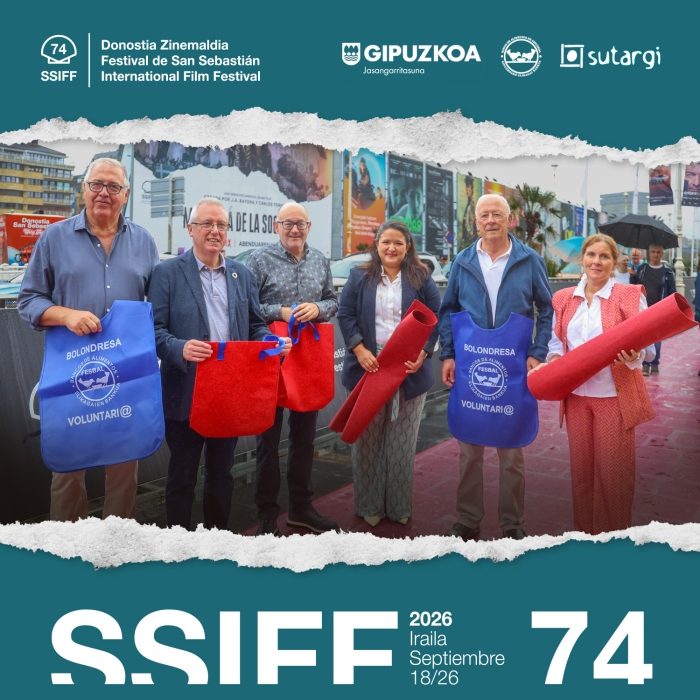
Once again this year the red carpet will accompany stars at the San Sebastián Festival; but its use won’t end when the lights go down. The 1,840 square metres of sustainable red carpet installed during the 74th edition of the Festival, thanks to the initiative of the Sustainability Department at Gipuzkoa Provincial Council, will go on to enjoy a second life at the end of the event, turning into 1,200 reusable bags for donation to the Gipuzkoa Food Bank.
This morning, the Deputy for Sustainability, José Ignacio Asensio, and the Festival director, José Luis Rebordinos, announced the project, accompanied by the vice-president of the Gipuzkoa Food Bank, Carlos Martinez, and the director-general of Sutargi, Mariangélica Martínez.
The initiative therefore turns its attention to applying circular economy principles to one of the most recognisable elements of a major cultural event, thereby preventing a material conceived for temporary use from being directly turned into waste.
This year the project includes a new social dimension on working with Sutargi, the company tasked with transforming the used carpet into new bags. The process will mean approximately 350 hours of inclusive work, carried out by workers in a situation of vulnerability.
The project therefore ties in three objectives: to reduce waste, to make better use of resources and to generate opportunities for people.
The Deputy for Sustainability, José Ignacio Asensio, highlighted the fact that initiatives such as this enable us to demonstrate that the transition towards a more circular economy “does not only lie in more recycling, but in changing the way we use resources and in finding new opportunities for materials before proceeding to consider them as waste”. In this respect, Asencio stressed that “the red carpet is not only a symbol of the Festival, but that it is also an example of how to do things differently: something that accompanies stars on their way through the streets of San Sebastián today can turn into bags for the Food Bank tomorrow, and, in so doing, generate inclusive employment”.
For his part, the director of the San Sebastián Festival, José Luis Rebordinos, stressed that “the red carpet is one of the Festival’s most recognisable features and represents its most glamorous side; but it can also serve as a reflection on and loudspeaker for its values. With this initiative we want to strengthen the idea that it is possible to combine the spectacular nature of such an iconic element with criteria of social inclusion and respect for the environment. For years now we have been demonstrating that sustainability, commitment and glamour can and must go hand in hand”.
The vice president of the Gipuzkoa Food Bank, Carlos Martínez, stressed that “the ongoing nature of this initiative proves that culture can continue far beyond its artistic aspect to become a true meeting point with the community. Giving a second life to an element so closely linked to the Festival and turning it into a resource for our social work team is an example of how the circular economy, solidarity and culture can walk the same path. From the Food Bank we are grateful for the opportunity to continue forming part of this project, which contributes as much to the responsible reuse of resources as it does to supporting those who need it most”.
In the words of the director-general of Sutargi, Mariangélica Martínez, “we thank the Council’s Sustainability Department, the Film Festival and the Food Bank for this marvellous collaboration enabling us to address this new concept of inclusive circularity. This project is completely in line with making responsible use of available resources while generating opportunities with real impact. We are convinced that approaching the circular economy as a cross-cutting endeavour not only helps vulnerable people to find work, but represents a development opportunity that allows them to put their talent at the service of the territory”.


















Monday to Sunday from 09:00 to 14:00
and from 16:00 to 20:00